
Restoration of Michel Perridon’s collection
Since 2020, Koolwijk Furniture Restoration has restored 63 pieces by Carlo Bugatti on behalf of collector Michel Perridon. The collection ranges from a small wall console and chairs to large cabinets, tables and a double bed.
Thanks to this extensive and diverse collection, a great deal of specialist knowledge has been built up regarding Bugatti’s use of materials, construction methods and finishes. The restored pieces feature, amongst other things, walnut, softwood, parchment, silk, brass, zinc, tin, copper, ivory, bronze, iron and eucalyptus seeds.
The unique combination of these materials requires a specific approach for each restoration, with the preservation of the original materials, finishes and character as the guiding principle.
The furniture collection forms part of The Perridon Collection, which, in addition to works by Carlo Bugatti, also includes cars by Ettore Bugatti and sculptures by Rembrandt Bugatti.
Carlo Bugatti (1856–1940) was the father of car manufacturer and designer Ettore Bugatti and sculptor Rembrand Bugatti. Carlo Bugatti was an Italian designer and maker of furniture, jewellery and musical instruments. Although his style is idiosyncratic, his designs are best categorised within the Liberty style and Art Nouveau. His designs are sometimes organic and biomorphic, with Moorish and exotic influences. In 1880, he began producing furniture in Milan and immediately gained recognition for his eclectic yet elegant furniture designs. By the end of the decade, he had already earned international renown. At the 1888 Exhibition of Industrial Art in Milan, his works were very well received and generated immediate demand from wealthy European clients. At the 1902 Exhibition of Modern Decorative Art in Turin, he confirmed his status as one of the most influential designers of his generation. His sons, Ettore (1881–1947) and Rembrandt (1884–1916), both followed in their father’s footsteps to become prominent designers. Carlo’s furniture, Ettore’s cars and Rembrandt’s sculptures are all collected internationally and sell for high prices.
Carlo Bugatti (2 February 1856, Milan, Italy – April 1940, Molsheim, France) was an Italian decorator, designer and manufacturer of Art Nouveau furniture, jewellery and musical instruments. His distinctive aesthetic combined the organic and the exotic in new ways, resulting in a body of work that was unique amongst the art of his contemporaries.
Carlo Bugatti was the son of the sculptor, interior designer and architect Giovanni Luigi Bugatti, and the father of the car manufacturer and designer Ettore Bugatti and the sculptor Rembrand Bugatti. Carlo received his early training at the prestigious Accademia di Belle Arti di Brera in Milan before moving to Paris in 1875, where he continued his studies at the internationally renowned Académie des Beaux-Arts. In 1880, he began producing furniture in Milan and immediately made a name for himself with his eclectic yet elegant furniture designs. By the end of the decade, he had already gained international renown.
At the Industrial Art Exhibition in Milan in 1888, his works were very well received and generated immediate demand from wealthy European clients. At the exhibition of modern decorative art in Turin in 1902, he cemented his status as one of the most influential designers of his generation. In the decades that followed, Bugatti continued to innovate and incorporate a wide range of motifs and styles into his works. From references to nature to echoes of the Moorish style, Bugatti explored the potential of the Art Nouveau era at the cutting edge of design thinking. His sons, Ettore (1881–1947) and Rembrandt (1884–1916), both followed in their father’s footsteps to become prominent designers. Following the suicide of his son Rembrandt in 1916, Carlo Bugatti, then aged 60, remained influential but produced fewer pieces. In 1935, at the age of 79, he moved with his wife Teresa to the town of Molsheim in Alsace, France, where his son Ettore lived, and retired. He died in Molsheim in 1940.

Carlo Bugatti cabinet made for Luisa Casati
This cabinet forms part of an interior commissioned by Luisa Casati. Luisa Casati was a…

Restoration Cobra chair, Snail chair and Snail Table
Restaoration snake table Carlo Bugatti Restoration Snail chair Carlo Bugatti Restoration Cobra chair Carlo Bugatti…
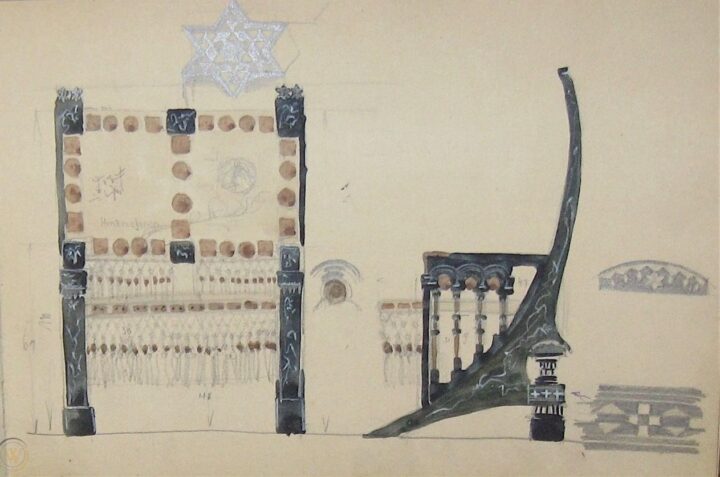
Restoration sofa by Carlo Bugatti
A short introduction on Carlo Bugatti Carlo Bugatti was a prominent Italian designer, active between…

Restoration of a set of signed Throne chairs by Carlo Bugatti
Before restoration began, these chairs were soiled. The silk braiding had disappeared and the inlay…

Restoration of two chairs by Carlo Bugatti
On these two chairs, the parchment had been replaced with fabric. This fabric had been…

Restoration Sgabello set by Carlo Bugatti
The Sgabello set, comprising two chairs (sgabello) and a matching table, is an early work…

Chairs by Carlo Bugatti
Restoration of various chairs by Carlo Bugatti. General work carried out: treating for woodworm; restoring…

Bugatti boekenkast
Open bookcase with a raised compartment. Work carried out: – Treated for woodworm – Cleaned…
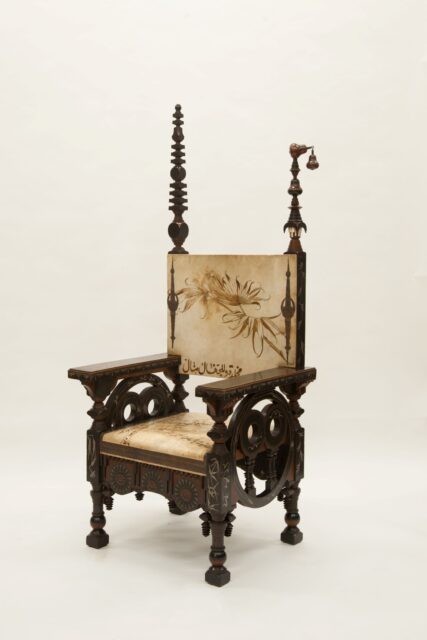
Throne chair Carlo Bugatti
Signed ‘Casati’. Work carried out: – Woodworm treated – Woodworm holes filled – All missing…

Carlo Bugatti desk


Carlo Bugatti painting
The canvas and frame were restored in collaboration with Erick Douwes of Douwes Fine Art…

Carlo Bugatti fernbox

Carlo Bugatti ladies’ desk
Mirrored cabinet / ladies’ writing desk. Condition prior to restoration: – Active woodworm – Soiled…